SWIFT
Sovereign multi-bearer message fragmentation, delivering assured comms when links are jammed, degraded or denied. SWIFT compresses data from any source and fragments it across every available bearer, so no single frame holds the message.
Demonstrated to Army at AID26
Communication dies on a single channel.
Links drop, but you don’t know until you send, wait and hear nothing. So you send it again, maybe on a different channel. Every repeat is more time on the net, more traffic for someone to detect, and more of the operator’s attention going on communications instead of the job.
Use the entire available spectrum, all at once.
SWIFT turns a thirty-second voice SITREP into milliseconds of data. Sensor data from an Unmanned Aerial System (UAS) or ground station is handled the same way: compressed, split across every available link and resent automatically if dropped. It works on any hardware, from a low-SWaP wearable device to a server at HQ.
SWIFT combines encoding, compression and fragmentation into one unified message survivability layer.
| Today | With SWIFT |
|---|---|
| A dropped link is invisible until the message fails. | A stalled link reports itself, immediately. |
| The operator resends by hand, on another channel. | Recovery is automatic. The operator sends once. |
| Jam one bearer and the message stops. | Every available bearer carries part of it. |
| A voice SITREP is thirty seconds on the net. | The same report is milliseconds of data. |
Capability benefits.
Harder to intercept or deny
No bearer carries a whole message, and the fragment distribution changes every send.
Delivery survives bearer loss
A bearer can die mid-send and the message still arrives, with no required operator action.
Less time on the net
Up to 10x compression turns a thirty-second voice SITREP into milliseconds of data.
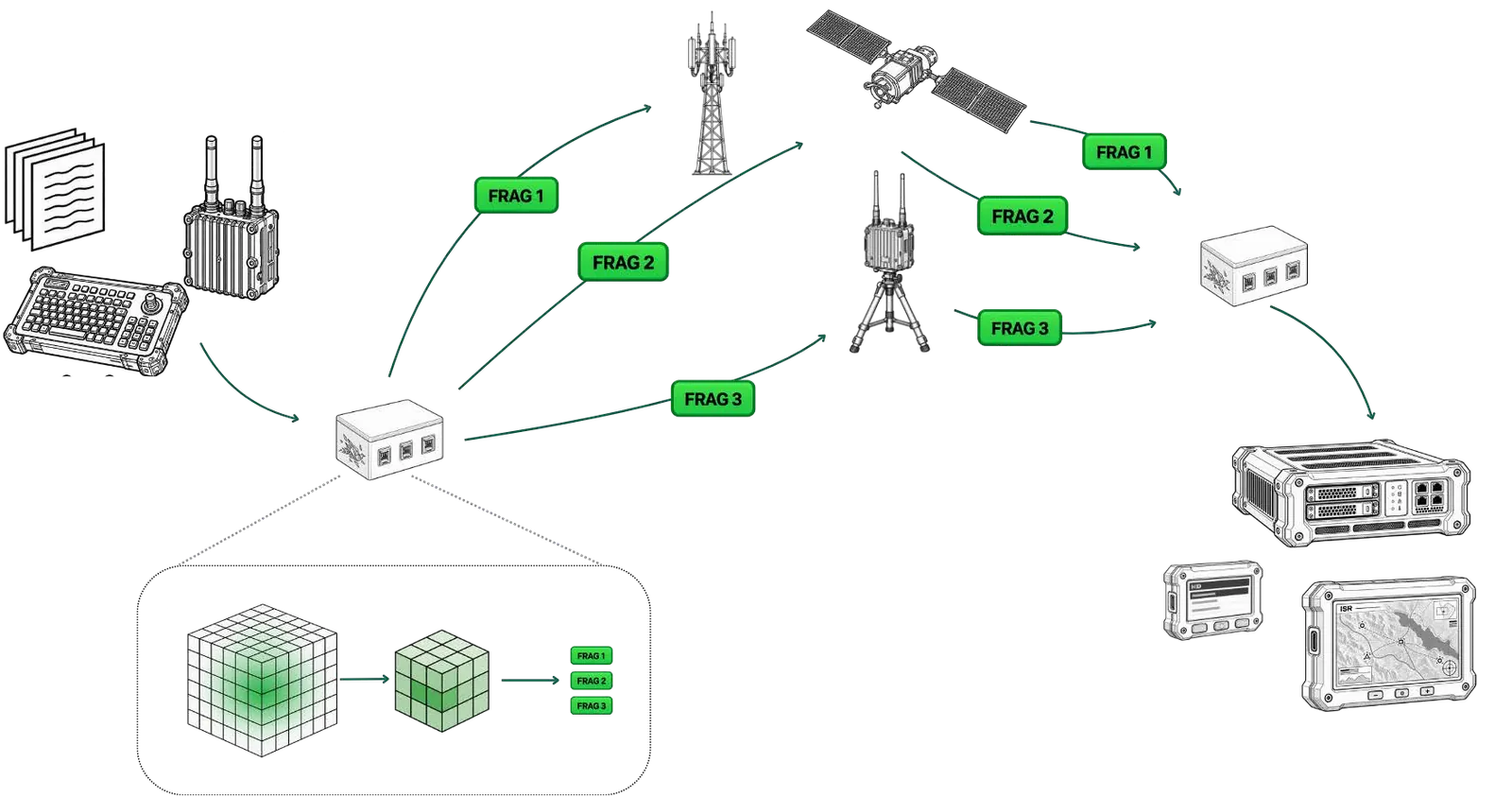
How SWIFT works
-
01
Normalisation
Inputs are normalised into the SWIFT data protocol.
-
02
Encoding and compression
Data is encoded and compressed using the SWIFT shared dictionary. Data is compressed up to 10x.
-
03
Fragmentation
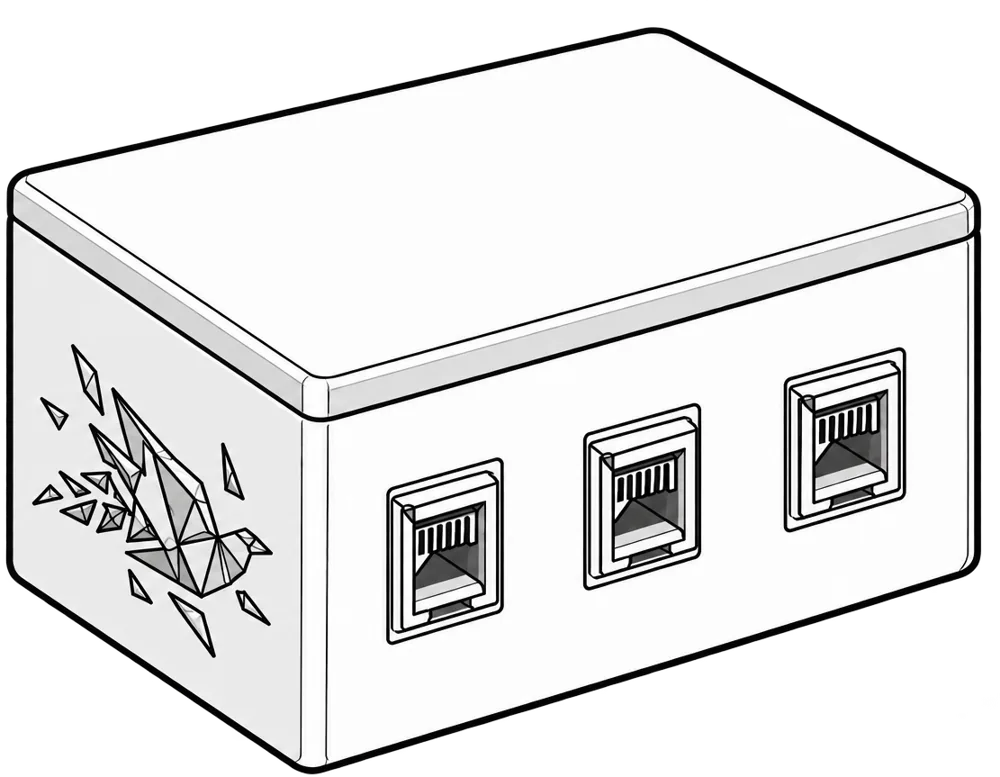
Compressed data is fragmented into at least two frames, with no single frame exceeding 32 bytes.
-
04
Multi-path routing
Fragments are transmitted on all available bearers, with no single bearer carrying the entire message.
-
05
Remote node
Receives fragments, reassembles and decompresses. Reports to the sending node on finish, or on missing fragments for re-transmission.
Why SWIFT is different
Agnostic
Bearer, input device, sensor, RATEL, big data. The core system moves any data, via any bearer, anywhere.
Low SWaP
Data link layer, microcontroller-class compute. Low power, low size.
Autonomous message survivability
Delivery does not depend on any one bearer, so the message gets through while any bearer remains.
Bearer disaggregation
Messages are split, not duplicated. An adversary intercepting one bearer gets an incomplete, meaningless fragment.
Predictive routing
Tracks bearer health trends to distinguish congestion from jamming, and reroutes before bearers fail rather than after.
Sits on existing radios
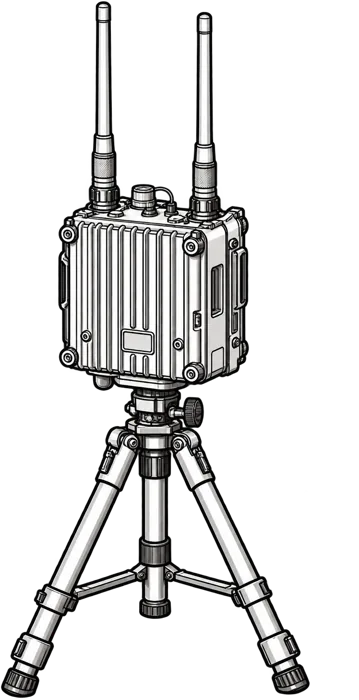
Connects via serial to existing tactical radio fleets. No new radios required.
Where SWIFT keeps the message moving.
Sensor data
Intelligence, Surveillance and Reconnaissance (ISR) and UAS reports compressed at source and sent across every bearer.
Tactical communications
Structured reports over the radios you already field, even when jammed.
Big data
Moves data to the data lake or cloud over whatever link is left.
Battle management and ATAK
Keeps battle management systems and ATAK current on degraded links.
Where SWIFT sits in SENTIA.
SENTIA is the Anywise framework that turns raw inputs into decision support, in six stages from sensor to commander. Explore SENTIA →
- Sense (SWIFT stage)
- Enrich (SWIFT stage)
- Nexus (SWIFT stage)
- Think (SWIFT stage)
- Inform (SWIFT stage)
- Assure (SWIFT stage)
SWIFT runs beneath all six
Adaptive multipath delivery that keeps the pipeline connected across degraded, disrupted, intermittent and low-bandwidth environments. It also feeds transport provenance into Assure.
We’d like to talk to you about your communications challenges and how SWIFT can help.
Tell us about your challenge. We'll show you where SWIFT fits.